
In order to trade safely, efficiently and at the lowest cost, you have to pay attention when choosing your broker.
Fortunately, there is a big competition between the numerous brokers on the market, so you have a large range to choose from, but you need to know what you are looking for.
There are 2 types of brokers:
1. Dealing Desks (DD) - Marker Makers
2. Not Dealing Desks, divided in:
A. Straight Through Processing (STP)
B. Electronic Communication Network + Straight Through Processing (ECN + STP)
1. Dealing Desks obtain profit from spreads and provide liquidity to their customers.
They compensate a client's Buy order with another client’s Sell order, thus offsetting 2 different trades. If there is no counter-trade or the currency demand and the offer of the customers are not equal in volume, the broker asks for help to his liquidity provider (is an entity that constantly buys and sells currency).
If liquidity cannot be ensured, the broker will be in a position to take the other side of the trade. The risk policy in such situations varies the broker to broker and must be carefully checked.
DD brokers do not display interbank network quotes, but the fierce competition among them prevents setting high spreads.
2. Not Dealing Desks do not process trades in their own system as Market Makers. They are simple ‘bridges’ between market participants. For their work they perceive a commission and / or increase the spread.
A. STP brokers - guide customers' orders directly to their liquidity provider, which has access to the interbank network. As a rule, these brokers work with multiple liquidity providers and direct the trades to the provider with lowest Ask Price or Bid Price in order to add a higher spread. Of course, broker provider’s quotes will not be displayed to customers. Variance of supplier’s quotes also explains the variable spreads perceived by most STP brokers.
B. ECN brokers - allow their clients to interact with other market participants: banks, independent traders, hedging funds, or even other brokers. Simply put, the participants trade within the network so formed at the best Ask / Price bid offered by one of them. This type of brokers shows the Depth of Market.
By its nature, the system does not involve paying spreads. In this case the broker charges a commission.

Strictly referring to the trading costs, what type of broker suits you depends on your own trading style.
Those who trade on short terms (a few minutes, one day) prefer lower spread brokers.
To make your choice easier, the table below shows the differences between the three types of brokers.
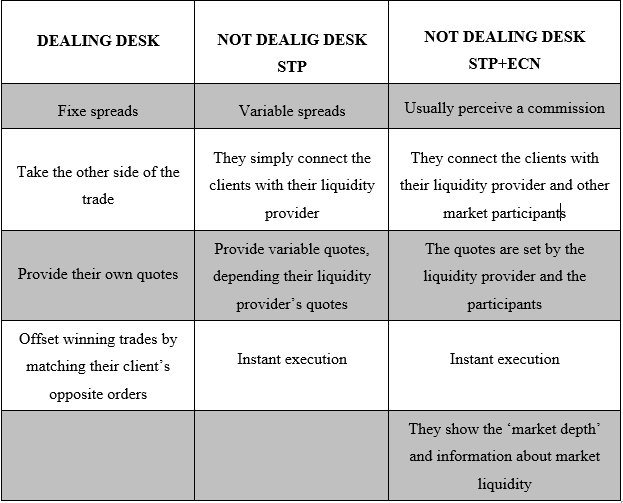
Brokers have a key role in the market, and their main purpose is not to make you lose or gain but keep you in the market. You will continue to trade so they will continue to charge spreads and commissions.
The purpose of this course is farther than that. We aim to train you to become a well prepared and informed trader. For this reason, we will present some criteria that you need to keep in mind when choosing a broker.
Criteria for Choosing a Broker:
1. Security
The security, the legitimacy of a broker is an essential feature to guide you. Fortunately, there are many regulatory ages as follows:
• US: National Futures Association (NFA) and Commodity Futures Trading Commission (CFTC)
• United Kingdom: Financial Conduct Authority (FCA) and Prudential Regulation Authority (PRA)
• France: Author HYPERLINK "http://www.amf-france.org/en_US/?langSwitch=true"é des Marchés Financiers (AMF)
• Germany: Bundesanstalt für Finanzdienstleistungsaufsicht (BaFIN)
• Switzerland: Swiss Federal Banking Commission (SFBC)
• Canada: Authorities des Marchés Financiers (AMF)
• Australia: Australian Securities and Investments Commission (ASIC)
Before choosing a certain broker and opening an account check if the broker is registered with one of these regulatory agencies.
2. Trading costs
Whenever we enter a trade (when the order is activated) we pay a spread or a commission. As we have already said, the costs agreed by each trader are related to their own trading style.
In choosing a broker, do not sacrifice security for lower costs.
3. Ease of account provisioning and liquidation
A good broker should ensure an easy process to feed you trading account and withdraw the profits. Otherwise, you would miss the very purpose for which you trade - to enjoy your earnings.
4. The efficiency of the trading platform
The efficiency of your trading depends also on a fully understanding of the broker's platform tools and their correct handling.
Check the platform's usage guidelines, its stability, and if you can use it easily.
Also, learn about other benefits of the platform – for example, the economic calendars.
5. Trade execution speed
It is essential that your broker performs the orders at the best available price.
Under normal market conditions (normal liquidity, lack of impact reports or surprise-events) and with a good internet connection the trades should be executed at the current Ask / Bid price.
Even a few moments, when the price has changed, can make a difference between gain and loss.
6. Solving Customer’s Requests (Customer Service)
Check if the broker offers a quick and satisfying answers/ solution to your notifications/requests related to the platform's issues.
Most brokers can be very kind and prompt at the account feed stage, but they can become less effective in resolving complaints during the collaboration.
Be aware of so-called Bucket Shops
The notion of Bucket Shops appeared in association with the fraudulent practices used in the past by certain brokers. The so-called bucketeers picked up customer orders and wrote them down on some forms, then dropping them in trash cans / buckets. Orders were never sent to the market and as the price movement was not displayed to the clients, the brokers could tell them that the price had evolved in the unfavourable direction.
Unfortunately, nowadays there are also such brokers who re-quote or mistaken quotations on purpose, who have a favourable slippage just for them or practice stop hunting.
The vast information sources and rigorous regulations allow you to avoid Bucket Shops and, eventually, defend your legal rights.
In this regard, before choosing a broker, check if he isregistered with a regulatory agency and read the reviews of its customers/former customers.
How can you protect yourself from scams?
Be aware and compare!
First of all, it is essential to identify a potential fraudulent action.
Do not focus strictly on the information provided by the platform. Subscribe to multiple sources of information. Otherwise, you won’t be able to identify any exaggerated spreads, mistakes, and so on.
Monitor and record everything!
Keep a log of all the orders you place in the market.
In this way, you will improve your strategy and correct the errors, but you also will increase your chances to identify a scam and prove it.
Search legal support.
If you have identified a Forex scam and you can prove it, we recommend, at first instance, an attempt to solve the problem with the broker.
If this fails, you can submit a complaint to the relevant regulatory agency. In this respect we recommend seeking professional legal support.
If you have any questions, do not hesitate to contact us in the contact section and one of our specialists will come back shortly with an answer.
The broker that best meets the above criteria and offers the best services is IC Markets Access the link to find out more information.
| MONTHLY YIELD | ||
|---|---|---|
| November 2025 | ||
| Procent + | Procent - | Total |
| 0.00 | 10.23 | -10.23 |
| October 2025 | ||
| Procent + | Procent - | Total |
| 23.02 | 0.00 | 23.02 |
| September 2025 | ||
| Procent + | Procent - | Total |
| 4.74 | 4.12 | 0.62 |
| TOTAL | 13.41 | |


